


What Is Ataxia?
You may have never heard the word Ataxia.
That’s exactly why we’re doing this.
Ataxia is a rare neurological disease that affects the nervous system and a person’s coordination. It can affect the ability to walk, talk, balance, use the hands, swallow, and control eye movements.
Ataxia Isn’t Just One Disease.
There are many different types of Ataxia, and they don’t all look the same.
Some forms are inherited. Some can appear even when there seems to be no family history at all. Others can be acquired because of another medical condition or event. Symptoms can begin in childhood or not appear until much later in adulthood.
There are more than 40 identified forms of Spinocerebellar Ataxia alone. Other forms include Friedreich Ataxia, Episodic Ataxia, Ataxia-Telangiectasia, Sporadic Ataxia, and many more.
The symptoms and progression can also be very different from one person to another. For some, the disease progresses slowly over decades. For others, changes can happen much more quickly.


15,000–20,000
Americans are estimated to have Spinocerebellar Ataxia.
Tens of thousands more are affected by recessive,
sporadic, and still-unknown forms of Ataxia.
Our Family’s Story
If you aren’t familiar with Ataxia, you’re not alone. I wasn’t either until it became part of our family’s lives.
I have four sons: Keith, Cody, and fraternal twins Jimmy and Dustin. All four grew up healthy and active, played sports, and went on to physically demanding jobs.
Two of my sons, Jimmy and Cody, have been affected by Spinocerebellar Ataxia Type 2 (SCA2). The disease was already part of their family history: their paternal grandmother, Alice, and their father, Jim, both lived with SCA2. Because the disease was so rare and not well understood, it took years for the family to receive answers.
When Jimmy was 14, I knew something neurological was happening. His diagnosis came quickly because we now understood the family history. He began losing his balance, and the disease progressed steadily. By the time he graduated high school, he needed help walking and an aide to scribe for him. One of the last times Jimmy walked without assistance was at his high school graduation.
Over the years, SCA2 continued to take away his independence. In 2017, Jimmy died at just 27 years old.
Years later, Cody began showing symptoms at around age 32. Today, after about six years of progression, he uses a wheelchair full time. He has learned to adapt—finding different ways to eat, use his phone, and continue doing as much as he can for himself. His speech has become increasingly difficult to understand.
One thing people may not realize is that Ataxia can make someone appear intoxicated. A person may stumble, lose coordination, and have severely slurred speech.
But they aren’t drunk. They have Ataxia.
Every day, we live with the challenges of what this disease continues to take away. But it has also changed our perspective. We adapt. We make the most of the time we have together. We laugh. We keep living. And when Ataxia changes the road ahead, we find another way forward.
This is our family. This is our reality. And this is why Ataxia awareness matters so much to us.

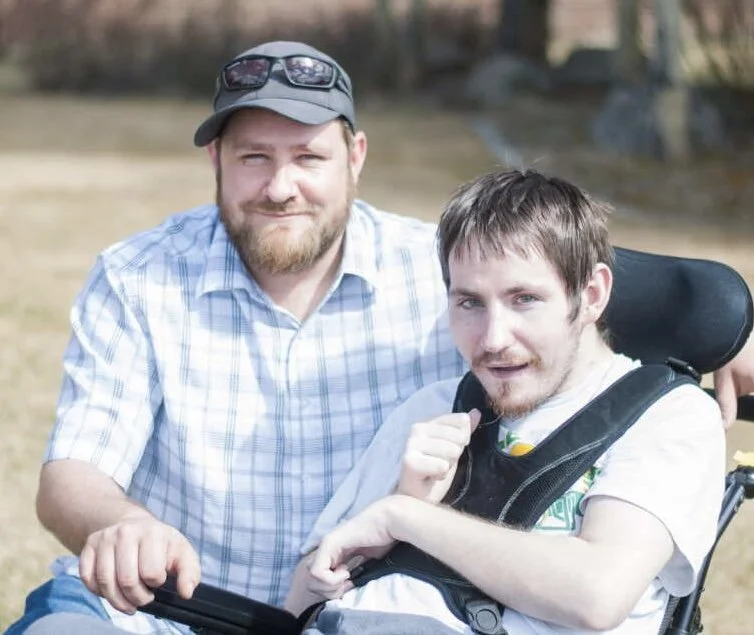
Brothers Cody & Jimmy
FOLLOW CODY ON TIKTOK
Let’s Make Rare a Little Less Invisible.
Learn the word.
Remember the word.
Share the word.
ATAXIA.
Help us spread awareness, support families, and move research forward.